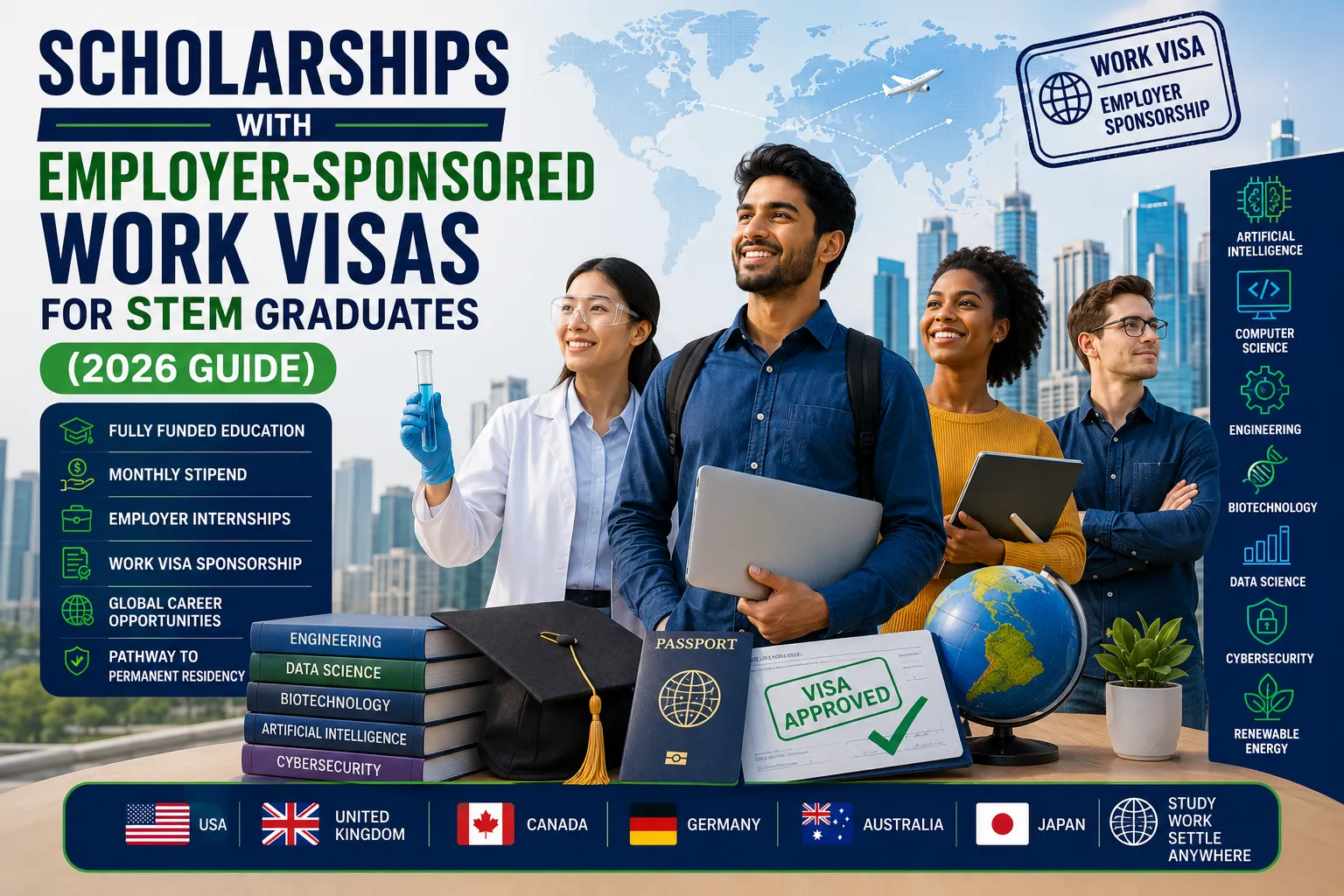
The demand for skilled professionals in science, technology, engineering, and mathematics (STEM) continues to grow worldwide. As industries face ongoing talent shortages, many governments, universities, and employers have developed scholarship programs that not only fund higher education but also create pathways to employer-sponsored work visas after graduation.
For international students, these opportunities can significantly reduce the cost of studying abroad while improving their chances of securing long-term employment and, in many cases, permanent residency.
Why STEM Scholarships Are Increasingly Linked to Work Visa Sponsorship
Countries competing for highly skilled professionals are investing heavily in international education. Rather than simply funding degrees, many scholarship programs now connect graduates with employers willing to sponsor work visas.
This approach benefits both students and employers by helping graduates transition directly into the workforce.
Key Benefits
Students may receive:
- Full or partial tuition funding
- Monthly living stipends
- Research assistantships or paid internships
- Employer networking opportunities
- Post-study work visa eligibility
- Employer-sponsored work visa pathways
- Opportunities to apply for permanent residency in eligible countries
These combined benefits make scholarship-to-employment programs one of the most attractive routes for international STEM professionals.
Leading STEM Scholarships with Work Visa Pathways
Fulbright Program (United States)
The Fulbright Program remains one of the world’s most respected international scholarship initiatives. While the scholarship itself does not automatically guarantee employment, many graduates continue into Optional Practical Training (OPT) and later obtain employer sponsorship through the H-1B visa program.
Benefits
- Tuition assistance
- Living allowance
- Health benefits
- Research opportunities
- Academic exchange experience
Strong Fields
- Computer Science
- Artificial Intelligence
- Engineering
- Robotics
- Data Science
- Biotechnology
- Biomedical Research
Potential Career Path
Student Program → OPT → Employer Sponsorship → H-1B Visa
Chevening Scholarships (United Kingdom)
Chevening Scholarships support outstanding international students pursuing master’s degrees in the UK. After graduation, eligible students may transition into employment through the Skilled Worker visa if they receive a qualifying job offer.
Benefits
- Full tuition coverage
- Monthly stipend
- Travel expenses
- Visa application support
- Networking opportunities
Popular STEM Fields
- Artificial Intelligence
- Cybersecurity
- Renewable Energy
- Engineering
- Digital Technology
Career Progression
Student Visa → Graduate Employment → Skilled Worker Visa
Vanier Canada Graduate Scholarships (Canada)
The Vanier Canada Graduate Scholarships are designed for doctoral students with exceptional academic achievement and research potential.
Graduates may later qualify for Canada’s Post-Graduation Work Permit (PGWP), allowing them to gain valuable work experience before pursuing employer sponsorship or permanent residency.
Benefits
- CAD $50,000 annual scholarship
- Research funding
- Study permit eligibility
- Access to post-graduation work opportunities
Best Fields
- Engineering
- Information Technology
- Medical Sciences
- Environmental Sciences
- Artificial Intelligence
Career Route
Study Permit → PGWP → Employer Sponsorship → Permanent Residency
DAAD Scholarships (Germany)
Germany’s DAAD scholarships provide excellent opportunities for international students pursuing advanced degrees and research in STEM disciplines.
Graduates can often transition into skilled employment and later qualify for the EU Blue Card if they meet salary and employment requirements.
Benefits
- Tuition-free education at many universities
- Monthly stipend
- Health insurance support
- Travel assistance
- Research funding
Ideal Disciplines
- Mechanical Engineering
- Computer Science
- Renewable Energy
- Mathematics
- Physics
- Artificial Intelligence
Career Route
Student Visa → Skilled Employment → EU Blue Card
Australian Government Research Training Program
Australia offers several government-funded research scholarships for postgraduate students. Eligible graduates may move into skilled employment through employer-sponsored visa pathways, including the Skills in Demand visa (which has replaced the former Temporary Skill Shortage (subclass 482) visa framework).
Benefits
- Tuition fee coverage
- Annual living stipend
- Relocation assistance
- Research support
Popular Fields
- Engineering
- Mining
- Construction
- Medicine
- Data Analytics
- Environmental Science
Career Path
Student Visa → Employer Sponsorship → Skilled Migration Opportunities
MEXT Scholarship (Japan)
The Japanese Government (MEXT) Scholarship supports international students pursuing undergraduate, master’s, and doctoral studies.
Japan’s expanding technology sector provides strong employment opportunities for graduates in engineering and scientific research.
Benefits
- Full tuition
- Monthly stipend
- Airfare
- Language preparation where applicable
High-Demand Areas
- Robotics
- Electronics
- Manufacturing
- Computer Engineering
- Materials Science
Career Progression
Student Visa → Employment → Engineer/Specialist in Humanities/International Services Visa (or another qualifying work status depending on the role)
Scholarship Comparison
| Scholarship | Tuition | Living Stipend | Initial Visa | Typical Employment Pathway |
|---|---|---|---|---|
| Fulbright (USA) | ✔ | ✔ | J-1 or F-1 | OPT → Employer-Sponsored H-1B |
| Chevening (UK) | ✔ | ✔ | Student Visa | Graduate Route or Skilled Worker Visa |
| Vanier (Canada) | ✔ | ✔ | Study Permit | PGWP → Employer Sponsorship → PR |
| DAAD (Germany) | ✔ | ✔ | Student Visa | Skilled Employment → EU Blue Card |
| Australian Government RTP | ✔ | ✔ | Student Visa | Employer Sponsorship → Skilled Migration |
| MEXT (Japan) | ✔ | ✔ | Student Visa | Employment → Japanese Work Visa |
Understanding Employer-Sponsored Work Visas
Many scholarship recipients eventually qualify for employer-sponsored immigration programs after completing their studies.
United States
Graduates commonly begin with Optional Practical Training (OPT). Eligible employers may later sponsor an H-1B visa for specialty occupations. Individuals with exceptional achievements may also qualify for the O-1 visa.
United Kingdom
Graduates who receive qualifying job offers from licensed employers can transition to the Skilled Worker visa.
Canada
International graduates often use the Post-Graduation Work Permit to gain Canadian work experience before pursuing employer-sponsored pathways or permanent residency through federal or provincial immigration programs.
Germany and Other EU Countries
Highly qualified professionals earning above the required salary threshold may qualify for the EU Blue Card, which provides a route to long-term residence in participating European countries.
Australia
Qualified graduates working in occupations experiencing skill shortages may be eligible for employer-sponsored visas and, depending on the pathway, permanent residency options.
Japan
Graduates employed in qualifying technical or professional roles can apply for an appropriate Japanese work visa based on their occupation and qualifications.
How to Apply Successfully
Choose the Right Scholarship
Focus on programs that provide:
- Full or substantial financial support
- Strong research opportunities
- Internship placements
- Employer partnerships
- Post-study employment options
Prepare Strong Academic Documents
A competitive application typically includes:
- Excellent academic transcripts
- Updated CV or résumé
- Research publications or projects (if available)
- Recommendation letters
- Proof of language proficiency where required
Write a Compelling Statement of Purpose
Your Statement Should Explain
- Your academic background
- Research interests
- Career objectives
- Why the scholarship matches your goals
- How your work could contribute to innovation in your field
Submit Applications Early
Many scholarship deadlines fall between September and January. Starting several months in advance allows enough time to gather supporting documents and secure recommendation letters.
Prepare for Interviews
Some programs include interviews focusing on:
- Academic achievements
- Research experience
- Leadership potential
- Career plans
- Technical knowledge
Complete the Visa Process
Once admitted, your university will generally provide documentation needed for your student visa application. After graduation, employer sponsorship depends on securing a qualifying job offer and meeting the immigration requirements of the destination country.
Official Scholarship Websites
Always apply through official scholarship portals:
- Fulbright Program (USA): https://foreign.fulbrightonline.org
- Chevening Scholarships (UK): https://www.chevening.org
- Vanier Canada Graduate Scholarships: https://vanier.gc.ca
- DAAD Germany: https://www.daad.de
- Australian Government Research Training Program: https://www.education.gov.au/research-training-program
- MEXT Japan Study Information: https://www.studyinjapan.go.jp
Frequently Asked Questions
Do these scholarships automatically include employer-sponsored work visas?
No. Most scholarships do not guarantee a work visa. Instead, they provide education and, in many cases, access to post-study work options that can lead to employer sponsorship if you secure an eligible job.
Which countries offer the strongest opportunities for STEM graduates?
The United States, Canada, the United Kingdom, Germany, Australia, Japan, and several other developed economies continue to experience strong demand for qualified STEM professionals.
Is prior work experience required?
Not necessarily. Many scholarships accept outstanding students directly after completing their undergraduate degree, while others prefer applicants with research or professional experience.
Are living expenses covered?
Many fully funded scholarships provide monthly stipends that help cover accommodation, food, transportation, and other living costs. Coverage varies by program.
Can these programs lead to permanent residency?
In many cases, yes. Countries such as Canada, Australia, Germany, and the United Kingdom offer immigration pathways that may eventually lead to permanent residency for eligible skilled workers.
Final Thoughts
STEM scholarships combined with post-study employment opportunities provide an excellent pathway for international students seeking world-class education and global careers. Beyond funding tuition, these programs can open doors to research experience, industry connections, and employment in sectors facing critical talent shortages.
While no scholarship can guarantee a future work visa, choosing programs with strong employer partnerships and established post-study work pathways can significantly improve your chances of building a successful international STEM career.